
I recently made this post on Instagram, in which I showed this doodle:
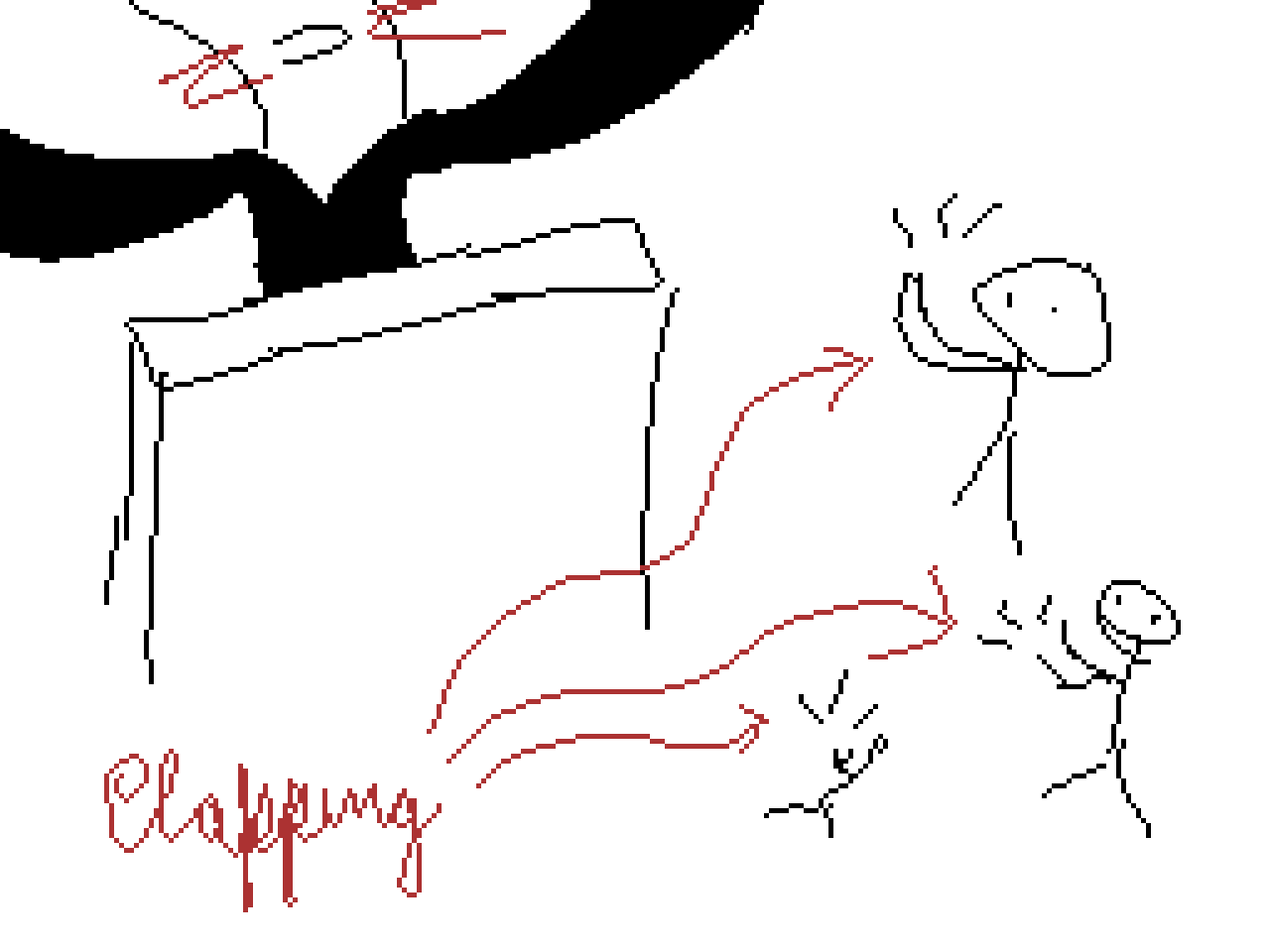
With the following caption:
then they clapped. for the orator. not knowing his meaning, only his words.
look to the side, look to the side! see what he is doing or what she is doing. those bindings the social bindings. are they frail? no they are not. neither should they be.
don’t break them! hear ye hear ye!
but why then do these unknowing claps bother me (and they do)? is it because i wish theirs to be like mine and i am lonely or is it because i wasn’t gifted hands like theirs?
yuh.
-yours, yurodivy.
(not so many of us is needed, so could those who aren’t us not be “real” and are they not true to themselves? im not so sure and yet maybe)
Quite a “sketchy” format, isn’t it? Incorrect punctuation, capitalization, etc. And yet, I find it quite appealing.
That is, it is aesthetically appealing for me. The idea in the paragraph, first of all, is good. The presentation, however, is not “traditionally” good. I can, however, feel the texture of the words on my palate, which is often what I find most enjoyable when it comes to fiction prose.
I think it is the produced rhythm?
This feeling on my palate is quite rare, however. I don’t typically experience it with poetry, like perhaps many others do, though this is likely an insufficiency on my part. However, in narrative prose with unique styles, I do.
And it is something I seek. But it can’t be surface level. If you have “painterly prose” like this, the ideas have to be good as well. Style like this, without substance—or without deep substance (“I feel eros toward you”, as an example)—makes this sort of writing feel cheap. However, if paired with depth of idea, this sort of content, again, attacks the palate in a manner unknown to more traditional writing.
If you don’t know what I mean by “attacks the palate”, your senses may be hooked up differently than mine, haha. Really, I think what I am proposing is that the work affects the senses rather than the brain and emotions. This flavor is revealed through an author’s style. It is arguably their spirit.
I think my spirit looks like this:
optimism? hmmmm… its an ethical duty, not merely a trait.
When I mean to express:
Optimism is our ethical duty.
Cormac McCarthy might say:
The men they didn’t know that what they believed wasn’t what was true and they believed that ethical duties did not include optimism but it did.
(I’m not very good at mimicking others, but that is my poor attempt. There may be some Hemingway accidentally thrown in there as well. Oops.)
That is to say, examples from me and from me mimicking McCarthy have this… “Sensation”, to them, that I find lets me understand the meaning more than the direct approach. The direct approach more easily lets me hear but not more easily understand. The indirect approach “circumnavigates the skin”.
Now, for some more practical thinking: how do we get this sort of painterly, sensory texture into modern visual novels?
I haven’t released it yet, but I think that I get close with Concorrenza. Sometimes, with this story, I fear that I lose the flavor, but to be fair I wasn’t thinking about this flavor when I started or ended so that’s to be expected.
The problem, however, should be stated: it wouldn’t make sense (in my head) that every character should speak like this. And I also believe that if the narrator was to speak like this at all times, it would not feel correct either. So how do we get this feel without actually putting it in prose?
Well, I suppose if we break down what I mean by “painterly”, it will make sense. Here are the qualities that make up “painterly”:
- Imperfect.
- Indirect, often implicit rather than explicit. Circling around the truth rather than stating it.
- Rhythmic over formally correct.
And that’s about it. Really, per usual, this aesthetic is “first-draft-y”, a quality I’m constantly looking for. I want the idea to be ambient rather than direct. I want to move past your skin.
In fiction, of course. Not necessarily in non-fiction.
Non-fiction is less intrusive.
We want this “ambient” quality because it lets us grasp more than we can understand ourselves. I’ve, on several occasions, gone back to Everything I Know, and Everything I’m Ever Gonna Know and realized a connection I hadn’t made intentionally. It is the power of this “encompassing” method.
Fiction writing is quite powerful, isn’t it?