
Have you ever held onto a high bar and attempted to create momentum and swing from idle? It is so hard. There is a technique to it, but in reality, for most, when starting, the best tactic is to flail wildly until you gain momentum by chance.
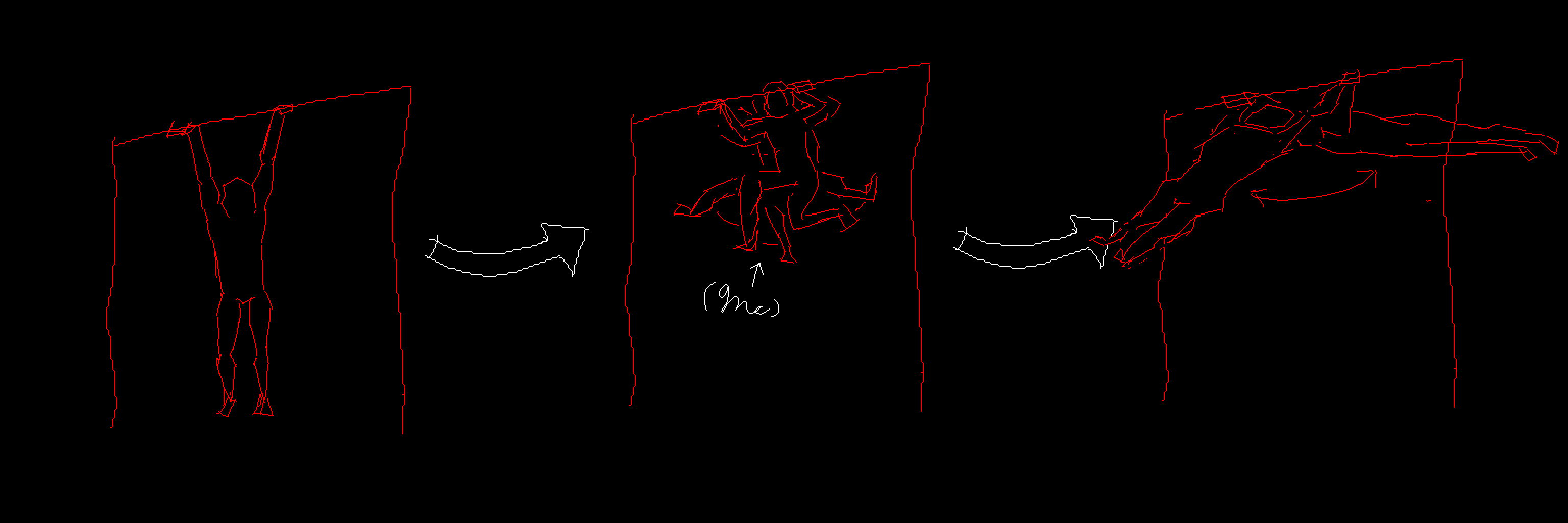
This is where I’m at with marketing.
I’m trying so many things, and some of it is working, but most of it is not. This particular writing is for me to share and ruminate on my findings up to this point.
What’s failed? Reddit, for one. Reddit has been a good tool for art criticism in some ways — in particular, understanding how my art will be perceived from different sects of the internet. Good toughening up, if you will. A crucible. I hope it also to be a good tool for evangelizing the concept of the “modern visual novel”.
What it has not been good for is gaining new followers or wishlists, etc. I’ve tested this enough to rule out the use of Reddit as a major marketing tool. I don’t think almost any of my wishlists have come from here, though I don’t know for sure.
I’ve also tried posting on X comment threads designed, in theory, to give awareness to indie projects. This, I believe, has had some sort of impact on my wishlist count, but seemingly not nearly enough to warrant the effort and ethical iffiness — that is, I do not find it very becoming of my studio or myself to post in these sorts of ways.
Simply posting trailers on YouTube as a means of gaining traction is also a failed method for the amount of work they take. The first trailer took easily at least a day of man-hours and has just shy of 250 views since the time of writing this. This is after months.
I’ve also mass sent out a press kit to 83 influencers who I considered “in my target demographic”. This was about a month ago, and I’ve received zero responses.
This sounds like a lot of gloom. And yet, a few things have worked.
For one, Steam generally does actively show product. Seemingly to the right audience, as, at the time of writing, the app has 22,524 impressions and 8,357 visits. This is a clickthrough rate of 37.1%¹. This not only means that Steam is showing it to a good number of people, it is also showing it to people who would be interested by the thumbnail and title. The problem is, my current total wishlist count is 146… Meaning that there is something wrong occurring when the individuals hit the store page. I feel in my gut that the problem to be solved is not the style in which representing the product via the store page, as I believe it is an accurate representation. Instead, I genuinely believe the problem is that Everything I Know, and Everything I’m Ever Gonna Know is failing to excite audiences despite my belief that it is a product of quality, but more on this later.
Kickstarter has also been a net success. Not directly — it is clear the campaign will not reach its goal — but indirectly. 4Gamer.net, a major Japanese gaming news outlet, covered the campaign, giving me additional eyes on the product as well as legitimacy which can be used at a later time. Here too, however, given the unlikelihood of success for the campaign, we see Everything I Know, and Everything I’m Ever Gonna Know failing to capture audiences through its general outward presence. An article was written on a major news site — a good article, at that — and yet, only ~50 wishlists were gained. I can’t help but humble myself to recognize that there is likely a reason for this.
Now, let’s consider why the product’s web presence may not be resonating in order that we may pivot in the future. Again, I do believe that the web presence is correct for the product, so it is more innate to how much marketing potential Everything I Know, and Everything I’m Ever Gonna Know has. So in regard to this, I believe its three main flaws are in localization, visuals and subject matter.
In terms of visuals, honestly I believe my biggest failure was in my own lack of deep knowledge of the visual arts. So gesture, lighting, etc. I’ve alleviated both this and, what I’d consider a less big issue, though an issue nonetheless: the not fully defined style. There was more work to do, which is acceptable as this was my maiden voyage in modern visual novel art directing, but again, I believe I’ve solved this for my next project.
The next major issue is in my lack of localization. Or, even real capacity for localization. As mentioned earlier, 4Gamer.net is the first news site to write an article on the product. American news sites have yet to acknowledge me. Of the 146 wishlists I have, ~50 of them are from Japan, and this is without a Japanese localization. It goes further than this, however, in that I’ve had direct messages from individuals asking for Russian localization, with my most non-United States, non-Asian site visits coming from the Russian Federation. All this to say, the positive interaction that I’ve had has mostly come out of other cultures. Perhaps they “get it” more? Similar works such as Enjoy the Diner do well elsewhere, so I suspect that the modern visual novel may be an easier sale in other cultures.
As for subject matter: the core of the story revolves around social implications of fornication, which, understandably, is not particularly palatable to most audiences and is a bit hard to pitch. I was never really able to figure out how to market this appropriately. Partly because the revelation of this is a major plot point, and also because, well, it is a topic that should be handled with care.
Here is what I’d do instead: continue to rely heavily on aesthetics as a means of marketing, but also be considerate of how story scaffolding pairs with said aesthetic. They do not (necessarily) need to be directly aligned, but they should pair more intentionally than was done in Everything I Know, and Everything I’m Ever Gonna Know. I felt as though I had a great marketing handicap as I tried to avoid the true nature of the story. Again, this was the right choice for this product, but it would make my marketing life easier if I could use story scaffolding as a beat. Plus, if it is an interesting pairing with the aesthetic, a certain synergy will emerge.
The work in progress story scaffolding of my next novel remains provocative, but is less delicate, allowing it to be more easily used across marketing. “Enjoy your life working at a Korean coffee shop, and then go to hell.” Yes, “go to hell” is provocative, but it is not delicate. I can throw that at people and it won’t provoke the same vitriol that “social implications of fornication” does — at least, I suspect. Additionally, all this dances around with the current planned aesthetics rather than being completely unrelated as I did in Everything I Know, and Everything I’m Ever Gonna Know, in which the story and aesthetics were completely disjointed. My next product is actually visually set in the Korean countryside, and there is actually a depiction of hell. So the aesthetics actually do match the story scaffolding.
And before we finish, I do want to discuss one last thing. My reluctance to self-evangelize my art.
Up until recently, I had the strong belief that a product good enough would evangelize itself. In certain conditions, I continue to believe this. However, I can’t help but admit that I do not fit these conditions. I believe the conditions that must be met for a great product to evangelize itself are for it to fit on a gradient from other great products.
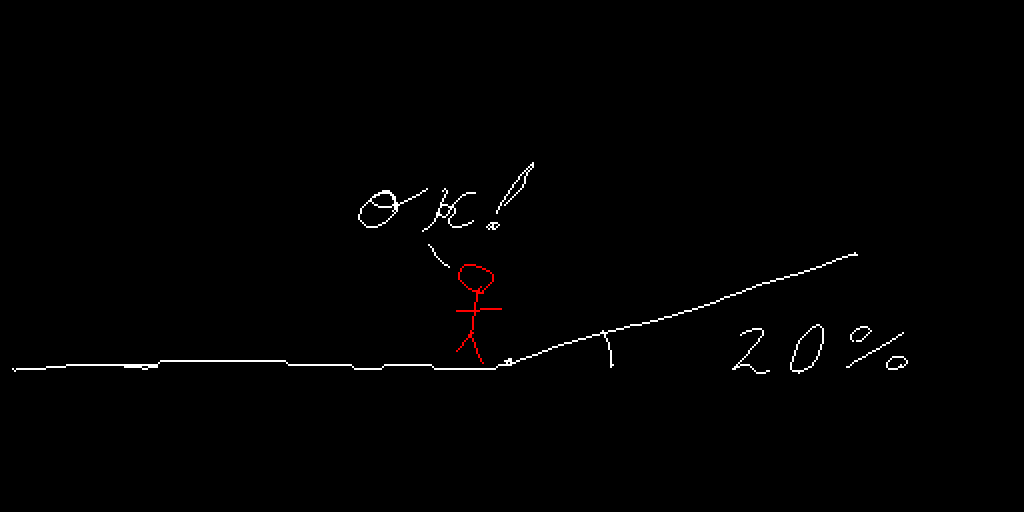
Perhaps more precisely, I believe a self-evangelizing product has to borrow about ~80% from the trends that are already popular and introduce ~20% new. Everything I Know, and Everything I’m Ever Gonna Know is, in my estimations, ~50% old and ~50% new, making the gradient too great to be naturally palatable by an audience with pre-formed expectations.

If the product is this different, but is still truly great, it requires evangelizing. Evangelizing both by word of mouth, and by the one who, theoretically, knows it best: the creator. We see this throughout history with such examples as Steve Jobs and his computer for artists, Thomas Edison, or, in a more modern example, Elon Musk.
Again, this requires that a product be good if not great. If it is not at this level of quality, no amount of evangelizing will help it survive in the long run. Yet, if one were to not evangelize a disruptive product at all, the greater public would simply find it strange and not know what to do with such a thing.
¹Steam is actually telling me 32.9% for its percentage, but that math doesn’t add up, so I may be missing something.