I don’t have an inborn talent for visual art. I was lucky with music and writing, as those mediums just made sense. But my artistic sensibilities are strange and, to many, uncanny or directly uncomfortable. I am naturally drawn towards the stylings of works like Taiyo Matsumoto’s “Ping Pong”, Love-De-Lic’s “Chulip” or Masaaki Yuasa’s “Mind Game”. These are all nonconformist and have a sense of style that alienates at the same time that it resonates. My natural proclivity is to believe that this uncanny sort of visual is artful, but no one is claiming that works like this are traditionally beautiful:
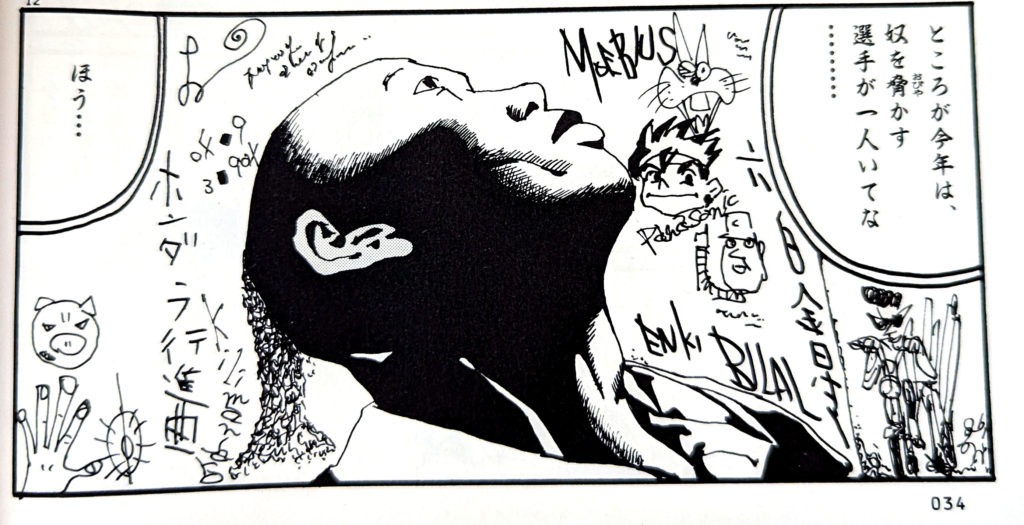
Panel shown for commentary/criticism; copyright remains with the rightsholder. Source: Mangasplaining (Substack)
And yet, I love it. I love it because of just how playful it is. It looks like Matsumoto loved his time creating it, and I respond to that joy.
There is, perhaps, a throughline from my initial inability to produce beautiful art to my proclivity for this exploration of the mildly uncanny but playful. This may or may not be true. This doesn’t, however, matter, as we are here, and I love to produce visuals like these:
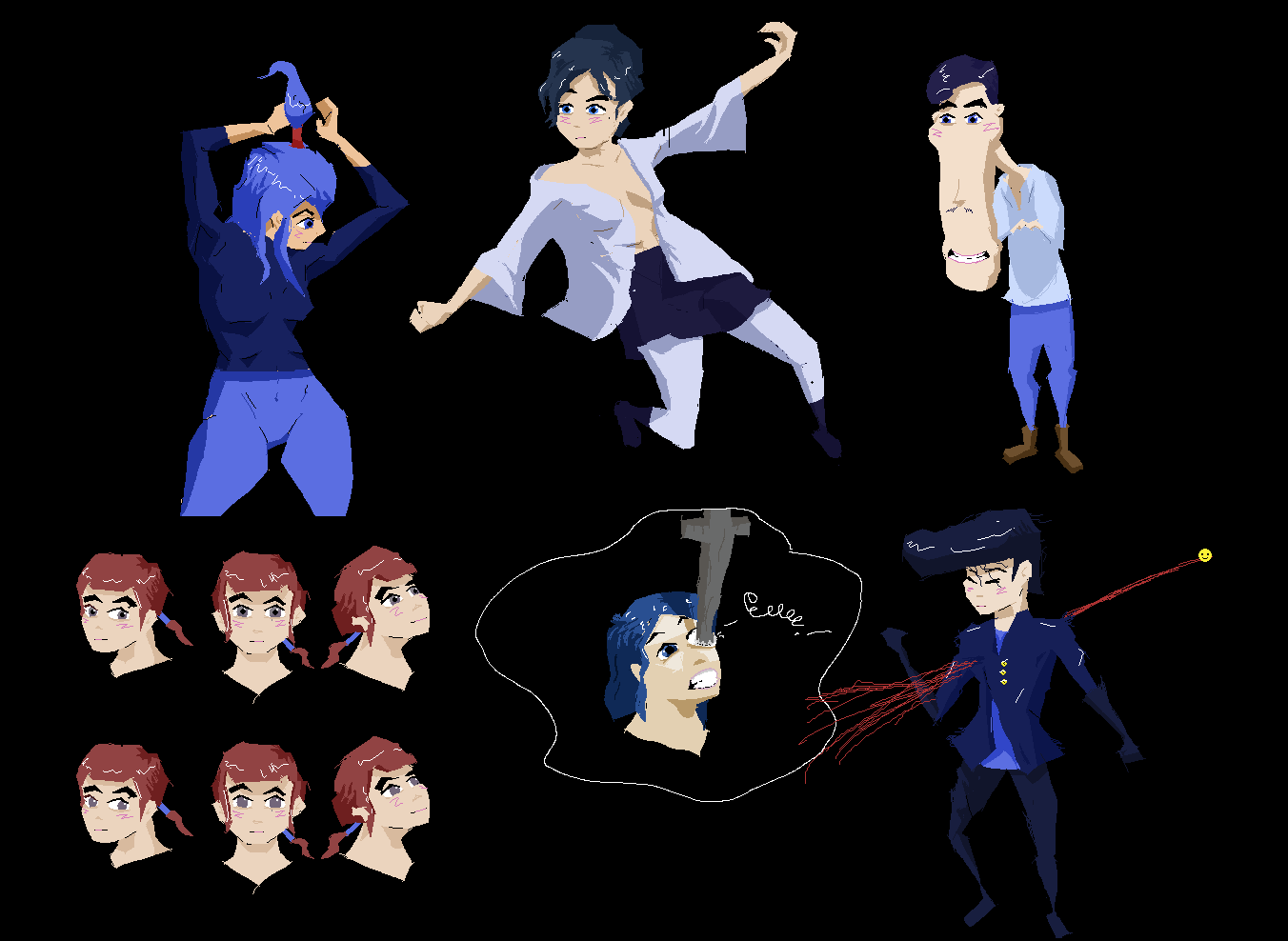
Ok, ok. Where I question all of this is when I consider the full scope of my personal mission. Namely, to “declare that which is sacred, sacred again”. And does this sort of imagery do this?
I’d say no. I’d say no, but there’s more to it. In one of the mental models I use for navigation of life, one must look at the world as a crucible of sorts. Refining and refining and refining. And yet, there’s another element to a crucible: the addition of new materials. We must try new things to progress. Do not conflate “sacred” with “traditional"¹. When I state that I wish to “declare that which is sacred, sacred again”, I do not mean to say that we got things 100% right at any particular era. Renaissance art, for example, is truly and undeniably beautiful, but there is a valid argument to be made that it is not the best style for every situation. For example, it has its limits in communication. If a piece is constrained by realism, we cannot emphasize particular qualities in a quickly readable manner. This, of course, is of great benefit for a painting, as it allows us to sit with it for longer periods of time, study it, and recognize details as we pass it for the umpteenth time. Beautiful.
But what about when creating a “modern visual novel” that is supposed to be read? Visuals pass by you rather quickly, and because of this, legibility perhaps has a sacredness to it greater than studiable detail. Don’t believe me? Think about alphanumeric characters. Words, even. What are these, but abstractions? Think then of these sorts of characters as lying somewhere on an abstraction plane between real physical world objects and words. Perhaps then they won’t feel so blasphemous.
To ask the question now directly: what should these visuals convey? We are now theorizing that they are abstracted, hitting an axis point somewhere between readability and the fully hermeneutically fertile (big phrase!), but what we functionally want them to do will determine where on this axis we lie.
Of course, every visual in a modern visual novel will have a different purpose. So let’s take simply the “portrait” concept and consider it, as this was a concept stolen from a “traditional visual novel” and is fairly ripe for this type of discussion. Think about what these functionally convey to the user’s mind. Primarily, the emotional language related through visage and gesture normally absent from purely textual writings. Yet, given the fact that many of these “portrait” images will be viewed over and over again, why not aim to display the emotional depth and interpretability of a great work of realism such as Leonardo’s The Mona Lisa?
To answer this, let us consider that the portrait is not only accompanied by additional information (text, additional visuals, etc) at any given time, but also that reuse is expected and even desired. Part of the brilliance of a work such as The Mona Lisa is to capture a moment so utterly exclusive and rich with depth that it allows a viewer to consider it to an arguably endless degree. Though, while wonderful in a frozen painting, it is this very complexity that muddies the communicative elements needed for our purpose. Our complexity does not come from an individual portrait, but from how the portrait interacts with any particular “page” of dialogue and all other communication going on at any moment. Great value also may be derived from seeing the same emotion paired with different context.
So we have an argument for simplicity and abstraction! However, this does not answer whether or not the “uncanny” nature blasphemes the same work that it is an element of… Is it mockery? Well, maybe we should go in at this with the perspective of play? See, the uncanny and the playful often go hand in hand.² This “slightly off” style. Competency with the desire to break the rules if it is more interesting. More fun. But is this distortion for the sake of play sacrilegious to something sacred? Is it an aberration? A subtle distortion of truth, a devil masquerading as an angel? Alas, though I suspect not, in truth I do not have an answer, though it seems apt for me to revisit this soon.
¹We must not conflate these terms, but also acknowledge the fact that that which is traditional is indeed more likely to be sacred.
²This is a topic for another time, but I believe the reason for this likely has to do with the contrast of elements that only come from experience, such as consistent volume, paired with elements generally associated with children or beginners, such as sketchy lines or mixing perspective.